
(Lady Chatterley),

The story concerns a young married woman, Constance (Lady Chatterley), whose upper-class husband, Clifford Chatterley, has been paralyzed and rendered impotent. Her sexual frustration leads her into an affair with the gamekeeper, Oliver Mellors. This novel is about Constance's realisation that she cannot live with the mind alone; she must also be alive physically.
[edit] Main characters
- Lady Chatterley is the protagonist of the novel. Before her marriage, she is simply Constance Reid, an intellectual and social progressive from a Scottish bourgeois family, the daughter of Sir Malcolm and the sister of Hilda. When she marries Clifford Chatterley, a minor nobleman, Constance (or, as she is known throughout the novel, Connie) assumes his title, becoming Lady Chatterley. Lady Chatterley's Lover chronicles Connie's maturation as a woman and as a sensual being. She comes to despise her weak, ineffectual husband, and to love Oliver Mellors, the gamekeeper on her husband's estate. In the process of leaving her husband and conceiving a child with Mellors, Lady Chatterley moves from the heartless, bloodless world of the intelligentsia and aristocracy into a vital and profound connection rooted in sensuality and sexual fulfillment.
- Oliver Mellors is the lover in the novel's title. Mellors is the gamekeeper on Clifford Chatterley's estate, Wragby Hall. He is aloof, sarcastic, intelligent and noble. He was born near Wragby, and worked as a blacksmith until he ran off to the army to escape an unhappy marriage. In the army, he rose to become a commissioned lieutenant — an unusual position for a member of the working classes — but was forced to leave the army because of a case of pneumonia, which left him in poor health. Surprisingly, we learn from different characters' accounts that Mellors was in fact finely educated in his childhood, has good table manners, is an extensive reader, and can speak English 'like a gentleman', but chooses to behave like a commoner and speak broad Derbyshire dialect, probably in an attempt to fit into his own community. Disappointed by a string of unfulfilling love affairs, Mellors lives in quiet isolation, from which he is redeemed by his relationship with Connie: the passion unleashed by their lovemaking forges a profound bond between them. At the end of the novel, Mellors is fired from his job as gamekeeper and works as a laborer on a farm, waiting for a divorce from his old wife so he can marry Connie. Mellors is a man with an innate nobility but who remains impervious to the pettiness and emptiness of conventional society, with access to a primal flame of passion and sensuality.
- Clifford Chatterley is Connie's husband. Clifford Chatterley is a young, handsome baronet who becomes paralyzed from the waist down during World War I. As a result of his injury, Clifford is impotent. He retires to his familial estate, Wragby Hall, where he becomes first a successful writer, and then a powerful businessman. But the gap between him and Connie grows ever wider; obsessed with financial success and fame, he is not truly interested in love, and she feels that he has become passionless and empty. He turns for solace to his nurse and companion, Mrs. Bolton, who worships him as a nobleman even as she despises him for his casual arrogance. Clifford is portrayed as a weak, vain man, displaying a patronising attitude toward his supposed inferiors. He soullessly pursues money and fame through industry and the meaningless manipulation of words. His impotence is symbolic of his failings as a strong, sensual man, and could also represent the increasing loss of importance and influence of the ruling classes in a modern world.
- Mrs. Bolton, also known as Ivy Bolton, is Clifford's nurse and caretaker. She is a competent, still-attractive middle-aged woman. Years before the action in this novel, her husband died in an accident in the mines owned by Clifford's family. Even as Mrs. Bolton resents Clifford as the owner of the mines — and, in a sense, the murderer of her husband — she still maintains a worshipful attitude towards him as the representative of the upper class. Her relationship with Clifford - she simultaneously adores and despises him, while he depends and looks down on her - is probably one of the most complex relationships in the novel.
- Michaelis is a successful Irish playwright with whom Connie has an affair early in the novel. Michaelis asks Connie to marry him, but she decides not to, realising that he is like all other intellectuals: a slave to success, a purveyor of vain ideas and empty words, passionless.
- Hilda Reid is Connie's older sister by two years, the daughter of Sir Malcolm. Hilda shared Connie's cultured upbringing and intellectual education. She remains unliberated by the raw sensuality that changed Connie's life. She disdains Connie's lover, Mellors, as a member of the lower classes, but in the end she helps Connie to leave Clifford.
- Sir Malcolm Reid is the father of Connie and Hilda. He is an acclaimed painter, an aesthete and a bohemian who despises Clifford for his weakness and impotence, and who immediately warms to Mellors.
- Tommy Dukes, one of Clifford's contemporaries, is a brigadier general in the British Army and a clever and progressive intellectual. Lawrence intimates, however, that Dukes is a representative of all intellectuals: all talk and no action. Dukes speaks of the importance of sensuality, but he himself is incapable of sensuality and uninterested in sex. Of Clifford's circle of friends, he is the one who Connie becomes closest to.
- Duncan Forbes is an artist friend of Connie and Hilda. Forbes paints abstract canvases, a form of art Mellors seems to despise. He once loved Connie, and Connie originally claims to be pregnant with his child.
- Bertha Coutts, although never actually appearing in the novel, has her presence felt. She is Mellors' wife, separated from him but not divorced. Their marriage faltered because of their sexual incompatibility: she was too rapacious, not tender enough. She returns at the end of the novel to spread rumors about Mellors' infidelity to her, and helps get him fired from his position as gamekeeper. As the novel concludes, Mellors is in the process of divorcing her.
[edit] Themes
In Lady Chatterley's Lover, Lawrence comes full circle to argue once again for individual regeneration, which can be found only through the relationship between man and woman (and, he asserts sometimes, man and man). Love and personal relationships are the threads that bind this novel together. Lawrence explores a wide range of different types of relationships. The reader sees the brutal, bullying relationship between Mellors and his wife Bertha, who punishes him by preventing his pleasure. There is Tommy Dukes, who has no relationship because he cannot find a woman whom he respects intellectually and, at the same time, finds desirable. There is also the perverse, maternal relationship that ultimately develops between Clifford and Mrs. Bolton, his caring nurse, after Connie has left.
[edit] Mind and body
Richard Hoggart argues that the main subject of Lady Chatterley's Lover is not the sexual passages that were the subject of such debate but the search for integrity and wholeness.[3] Key to this integrity is cohesion between the mind and the body for "body without mind is brutish; mind without body...is a running away from our double being."[4] Lady Chatterley's Lover focuses on the incoherence of living a life that is "all mind", which Lawrence saw as particularly true among the young members of the aristocratic classes, as in his description of Constance's and her sister Hilda's "tentative love-affairs" in their youth:
So they had given the gift of themselves, each to the youth with whom she had the most subtle and intimate arguments. The arguments, the discussions were the great thing: the love-making and connexion were only sort of primitive reversion and a bit of an anti-climax.[5]
The contrast between mind and body can be seen in the dissatisfaction each has with their previous relationships: Constance's lack of intimacy with her husband who is "all mind" and Mellors's choice to live apart from his wife because of her "brutish" sexual nature.[6] These dissatisfactions lead them into a relationship that builds very slowly and is based upon tenderness, physical passion, and mutual respect. As the relationship between Lady Chatterley and Mellors develops, they learn more about the interrelation of the mind and the body; she learns that sex is more than a shameful and disappointing act, and he learns about the spiritual challenges that come from physical love.
Neuro-psychoanalyst Mark Blechner identifies the "Lady Chatterley phenomenon" in which the same sexual act can affect people in different ways at different times, depending on their subjectivity.[7] He bases it on the passage in which Lady Chatterley feels disengaged from Mellors and thinks disparagingly about the sex act: "And this time the sharp ecstasy of her own passion did not overcome her; she lay with hands inert on his striving body, and do what she might, her spirit seemed to look on from the top of her head, and the butting of his haunches seemed ridiculous to her, and the sort of anxiety of his penis to come to its little evacuating crisis seemed farcical. Yes, this was love, this ridiculous bouncing of the buttocks, and the wilting of the poor insignificant, moist little penis."[8] Shortly thereafter, they make love again, and this time, she experiences enormous physical and emotional involvement: "And it seemed she was like the sea, nothing but dark waves rising and heaving, heaving with a great swell, so that slowly her whole darkness was in motion, and she was ocean rolling its dark, dumb mass."[9]
[edit] Class system and social conflict
Besides the evident sexual content of the book, Lady Chatterley’s Lover also presents some views on the British social context of the early 20th century. For example, Constance’s social insecurity, arising from being brought up in an upper middle class background, in contrast with Sir Clifford’s social self-assurance, becomes more evident in passages such as:
Clifford Chatterley was more upper-class than Connie. Connie was well-to-do intelligentsia, but he was aristocracy. Not the big sort, but still it. His father was a baronet, and his mother had been a viscount’s daughter.[10]
There are also signs of dissatisfaction and resentment of the Tevershall coal pit’s workers, the colliers, against Clifford, who owned the mines. By the time Clifford and Connie had moved to Wragby Hall, Clifford's father's estate in Nottinghamshire, the coal industry in England seemed to be in decline, although the coal pit was still a big part in the life of the neighbouring town of Tevershall. References to the concepts of anarchism, socialism, communism, and capitalism permeate the book. Union strikes were also a constant preoccupation in Wragby Hall. An argument between Clifford and Connie goes:
‘’Oh good!, said Connie. “If only there aren’t more strikes!”
“What would be the use of their striking again! Merely ruin the industry, what’s left of it; and surely the owls are beginning to see it!”
“Perhaps they don’t mind ruining the industry,” said Connie.
“Ah, don’t talk like a woman! The industry fills their bellies, even if it can’t keep their pockets quite so flush,” he said, using turns of speech that oddly had a twang of Mrs. Bolton.[11]
The most obvious social contrast in the plot, however, is that of the affair of an aristocratic woman (Connie) with a working class man (Mellors). Mark Schorer, an American writer and literary critic, considers a familiar construction in D.H. Lawrence's works the forbidden love of a woman of relatively superior social situation who is drawn to an "outsider" (a man of lower social rank or a foreigner), in which the woman either resists her impulse or yields to it.[12] Schorer believes the two possibilities were embodied, respectively, in the situation into which Lawrence was born, and that into which Lawrence married, therefore becoming a favorite topic in his work.
Familiar, too, to much of Lawrence's work is the nearby presence of coal mining. Whilst it has a more direct role in Sons and Lovers and in Women in Love, it casts its influence over much of Lady Chatterley's Lover too. Lawrence's own father was a miner, and the author was intimately familiar with the region of the Derby/Notts coalfield, having been born at Eastwood, Nottingham. The significance of coal in the background to Lawrence's novels cannot be overstressed, when considering his treatment of social class issues. Involved with hard, dangerous and health-threatening employment, the unionised and self-supporting pit-village communities in Britain have been home to more pervasive class barriers than has been the case in other industries (for an example, see chapter two of The Road to Wigan Pier by George Orwell.) They were also centers of widespread non-conformist (Non-Anglican protestant) religion, which tended to hold especially proscriptive views on matters such as adultery.
[edit] Controversy
An authorised abridgment of Lady Chatterley's Lover that was heavily censored was published in America by Alfred A. Knopf, Inc. in 1928. This edition was subsequently reissued in paperback in America both by Signet Books and by Penguin Books in 1946.
[edit] British obscenity trial
When the full unexpurgated edition was published by Penguin Books in Britain in 1960, the trial of Penguin under the Obscene Publications Act of 1959 was a major public event and a test of the new obscenity law. The 1959 act (introduced by Roy Jenkins) had made it possible for publishers to escape conviction if they could show that a work was of literary merit. One of the objections was to the frequent use of the word "fuck" and its derivatives. Another objection involves the use of the word "cunt".
Various academic critics and experts of diverse kinds, including E. M. Forster, Helen Gardner, Richard Hoggart, Raymond Williams and Norman St John-Stevas, were called as witnesses, and the verdict, delivered on 2 November 1960, was "not guilty". This resulted in a far greater degree of freedom for publishing explicit material in the United Kingdom. The prosecution was ridiculed for being out of touch with changing social norms when the chief prosecutor, Mervyn Griffith-Jones, asked if it were the kind of book "you would wish your wife or servants to read".
The Penguin second edition, published in 1961, contains a publisher's dedication, which reads: "For having published this book, Penguin Books were prosecuted under the Obscene Publications Act, 1959 at the Old Bailey in London from 20 October to 2 November 1960. This edition is therefore dedicated to the twelve jurors, three women and nine men, who returned a verdict of 'Not Guilty' and thus made D. H. Lawrence's last novel available for the first time to the public in the United Kingdom."
In 2006, the trial was dramatised by BBC Wales as The Chatterley Affair.
[edit] Australia
Main article: Censorship in Australia
Not only was the book banned in Australia, but a book describing the British trial, The Trial of Lady Chatterley, was also banned. A copy was smuggled into the country and then published widely. The fallout from this event eventually led to the easing of censorship of books in the country, although the country still retains the Office of Film and Literature Classification. In early October 2009, the federal institution of Australia Post banned the sale of this book in their stores and outlets claiming that books of this nature don't fit in with the 'theme of their stores'.
[edit] Canada
Main article: Censorship in Canada
In 1945, McGill University Professor of Law and Canadian modernist poet F. R. Scott appeared before the Supreme Court of Canada to defend Lady Chatterley's Lover from censorship. However, despite Scott's efforts, the book was banned in Canada for 30 years due to concerns about its use of "obscene language" and explicit depiction of sexual intercourse. On November 15, 1960 an Ontario panel of experts, appointed by Attorney General Kelso Roberts, found that novel was not obscene according to the Canadian Criminal Code.[13]
[edit] United States
In 1930, Senator Bronson Cutting proposed an amendment to the Smoot-Hawley Tariff Act, which was then being debated, ending the practice of having U.S. Customs censor allegedly obscene books imported to U.S. shores. Senator Reed Smoot vigorously opposed such an amendment, threatening to publicly read indecent passages of imported books in front of the Senate. Although he never followed through, he included Lady Chatterley's Lover as an example of an obscene book that must not reach domestic audiences, declaring "I've not taken ten minutes on Lady Chatterley's Lover, outside of looking at its opening pages. It is most damnable! It is written by a man with a diseased mind and a soul so black that he would obscure even the darkness of hell!"[14]
Lady Chatterley's Lover was one of a trio of books (the others being Tropic of Cancer and Fanny Hill), the ban on which was fought and overturned in court with assistance by lawyer Charles Rembar in 1959. It was then published by Grove Press.
A French film (1955) based on the novel and released by Kingsley Pictures was in the United States the subject of attempted censorship in New York on the grounds that it promoted adultery.[15] The Supreme Court held that the law prohibiting its showing was a violation of the First Amendment's protection of Free Speech.[16]
The book was famously distributed in the U.S. by Frances Steloff at the Gotham Book Mart, in defiance of the book ban.
[edit] Japan
The publication of a full translation of Lady Chatterley's Lover by Sei Ito in 1950 led to a famous obscenity trial in Japan, extending from May 8, 1951 to January 18, 1952, with appeals lasting to March 13, 1957. Several notable literary figures testified for the defense, but the trial ultimately ended in a guilty verdict with a ¥100,000 for Ito and a ¥250,000 fine for his publisher.
[edit] India
In 1964, bookseller Ranjit Udeshi in Bombay was prosecuted under Sec. 292 of the Indian Penal Code (sale of obscene books)[17] for selling an unexpurgated copy of Lady Chatterley's Lover.
Ranjit D. Udeshi v. State of Maharashtra (AIR 1968 SC 881) was eventually laid before a three-judge bench of the Supreme Court of India, where Chief Justice Hidayatullah declared the law on the subject of when a book can be regarded as obscene and established important tests of obscenity such as the Hicklin test.[18]
The judgement upheld the conviction, stating that:
When everything said in its favour we find that in treating with sex the impugned portions viewed separately and also in the setting of the whole book pass the permissible limits judged of from our community standards and as there is no social gain to us which can be said to preponderate, we must hold the book to satisfy the test we have indicated above.
DOWNLOAD HERE
The Furnished Room

This is perhaps the bleakest of O. Henry's best-known stories. Although the basic ironic plot can be summarized in a sentence—a young man commits suicide in the same room where a young woman for whom he has vainly searched killed herself—it is the musty atmosphere of the room and the suggestion that every place bears the traces of the lives that have inhabited it that makes the story so compelling. It is a story of transience, of lives that move through a bleak, indifferent world, leaving only bits of themselves, which the young man uncovers as he searches through drawers and pokes into every corner and crevice of the room looking for something that remains of the woman he seeks. However, all that is left is an illusory sweet familiar smell, which melodramatically becomes the sweet smell of the gas he turns on in despair, as she did only one week previously. Although the fact that the young man ends up in the very same room in which his lost sweetheart took her life is one of the most extreme coincidences in all of O. Henry's fiction, the power of the atmosphere of the story is so strong that readers are willing to accept it.
The story ends with two old Dickensian landladies prattling over their beer about the death of a young woman in the room the previous week, which the landlady has kept secret because she did not want to lose the young man's rent. As the young man lies dead upstairs, the ending of the story, with its focus on the mendacity of the old women, reinforces the squalor of the room, further suggesting the unfeeling city that has no room for the romanticism of the two lovers.
download here
The Hound of the Baskervilles
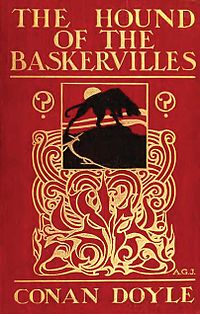
Sir Arthur Conan Doyle wrote this story shortly after returning to his home Undershaw from South Africa, where he had worked as a volunteer physician at the Langman Field Hospital in Bloemfontein.
He was assisted with the plot by a 30-year-old Daily Express journalist called Bertram Fletcher Robinson (1870–1907). His ideas came from the legend of Richard Cabell, which was the fundamental inspiration for the Baskerville tale of a hellish hound and a cursed country squire.
Cabell's tomb can be seen in the Devon town of Buckfastleigh.The legend is as follows:
Squire Richard Cabell lived during the 17th century and was the local squire at Buckfastleigh. He had a passion for hunting and was what in those days was described as a 'monstrously evil man'. He gained this reputation for, amongst other things, immorality and having sold his soul to the Devil. There was also a rumour that he had murdered his wife. On the 5th of July 1677, he died and was laid to rest in 'the sepulchre,' but that was only the beginning of the story. The night of his interment saw a phantom pack of hounds come baying across the moor to howl at his tomb. From that night onwards, he could be found leading the phantom pack across the moor, usually on the anniversary of his death. If the pack were not out hunting, they could be found ranging around his grave howling and shrieking. In an attempt to lay the soul to rest, the villagers built a large building around the tomb, and to be doubly sure a huge slab was placed on top of the grave to stop the ghost of the squire escaping.
Moreover, Devon's folklore includes tales of a fearsome supernatural dog known as the Yeth hound that Conan Doyle may have heard.
Conan Doyle's description of Baskerville Hall was inspired by a visit to Cromer Hall in Norfolk. Some other elements of the story are the product of a stay at the Royal Links Hotel in West Runton, where Conan Doyle first heard the story of Black Shuck—a ghost dog from the Cromer area, which is said to run between Overstrand in the east and East Runton in the west.[2] It is authoritatively noted that Baskerville Hall as first seen by Watson closely resembles the appearance of Conan Doyle's old school, Stonyhurst College in Lancashire, when viewed from its driveway
DOWNLOAD HERE
The Red Badge of Courage

The Red Badge of Courage is an 1895 war novel by American author Stephen Crane. It is considered one of the most influential works in American literature. Of all Crane's works, it has received the most attention from critics. The novel, a depiction on the cruelty of the American Civil War, features a young recruit who overcomes initial fears to become a hero on the battlefield. The book made Crane an international success. Although he was born after the war and had not at the time experienced battle firsthand, the novel is considered an example of American Naturalism.
The story is set during an unnamed battle of the American Civil War which bears numerous parallels to the historical Battle of Chancellorsville. 18-year-old Henry Fleming joins the Union Army despite discouragement from his mother (he has no father mentioned in the book, save that his mother says his father never drank alcohol), and becomes a private in the (fictional) 304th New York Regiment. In the weeks and days leading up to the conflict, Henry muses about whether he'll be brave, or will turn and run. During his first battle, Confederate soldiers charge his regiment, but are repelled. A few minutes later, they regroup and attack again. This time, when Henry sees some other people running and has his own fears that the battle is a lost cause, he deserts his battalion. However, when he gets to the rear of the army, he overhears a general saying that the army won anyway, and realizes he ran for nothing. Ashamed, he spends the rest of the day away from his regiment.
Escaping into a nearby forest, he finds a dead man decaying, alone in a clearing of the woods, and so comes face to face with the horror of death. He flees the forest, and finds a group of injured men returning from battle. One member of the group, the "Tattered Soldier", asks Henry (who is often referred to as "The Youth") where he is wounded, but Henry dodges the question. He also meets one of his friends, Jim Conklin, who has been shot in the side and is suffering dementia from bloodloss. He dies, and Henry runs away from the wounded soldiers.
Next Henry sees a retreating column, and grabs one of the men to try to ask for news. The panicked man hits Henry on the head with his rifle, bruising him. By this point, Henry is tired, hungry, thirsty, and has a head wound, and decides to return to his regiment regardless of his shame. When Henry returns to camp, the other soldiers believe his head injury resulted from a bullet grazing him in battle and care for him.
The next morning Henry goes into battle for the third time. They meet a small group of Confederates, and in the fight Henry proves to be one of the best fighters in the regiment. Afterward, while looking for a stream from which to get water with his friend, he discovers from the commanding officer that his regiment has a lackluster reputation. The officer speaks casually about sacrificing Henry's regiment because they are nothing more than "mule drivers" and "mud diggers". With no other regiments to spare, the general orders his men forward.
In the final battle, Henry acts as the flag carrier. A line of Confederates is hidden behind a fence beyond a clearing, and are able to shoot Henry's regiment with impunity, which is ill-covered in the tree-line. So, facing certain death if they stay, and disgrace if they retreat, the officers order a charge. Henry, unarmed, leads the charge, yet entirely escapes injury. Most of the Confederates at the fence run before the regiment gets there, and of the surviving soldiers, four Confederates are taken prisoner. The overall battle ends, and Henry and his regiment march back to camp.
download here
Boromir

Boromir is a supporting character in J. R. R. Tolkien's legendarium. He appears in the first two volumes of The Lord of the Rings (The Fellowship of the Ring and The Two Towers), and is mentioned in the last volume, The Return of the King.
He was the brother of Faramir and the eldest son of Denethor II, the last ruling Steward of Gondor.
Boromir was honourable and noble; he believed passionately in the greatness of his kingdom and would have defended its people to the very last. Boromir's great stamina and physical strength, together with a forceful and commanding personality, made him a widely-admired commander in Gondor's army: he was made Captain of the White Tower, and quickly became Captain-General, also bearing the title High Warden of the White Tower. He was also heir apparent to the Stewardship. Boromir led many successful forays against Sauron's forces, prior to his journey north to Rivendell, which brought him great esteem in his father Denethor's eyes.
Background
Boromir was born in the year 2978 of the Third Age to Denethor II and Finduilas, daughter of Adrahil of Dol Amroth. His younger brother, Faramir, was born in the year T.A. 2983. The following year, Denethor became Steward of Gondor, succeeding his father, Ecthelion II.
After Finduilas' death in T.A. 2988, Denethor became sombre, cold and detached from his family. As their father withdrew, the relationship between Faramir and Boromir grew closer and greater in love. Denethor always favoured Boromir over Faramir, but this caused no rivalry between the two brothers. Boromir always protected and helped Faramir. Boromir was judged to be the more daring one, as well as the more fearless.
In response to prophetic dreams that came to Faramir and later to himself, Boromir claimed the quest of riding to Rivendell from Minas Tirith in T.A. 3018. His journey lasted 110 days, and he travelled through "roads forgotten" to reach Imladris, though, as he said, "few knew where it lay".[1] Boromir lost his horse half-way along, while crossing the Greyflood at the ruined city of Tharbad where the bridge was broken. He had to travel the remaining way on foot. (Tolkien wrote of Boromir's journey that "the courage and hardihood required is not fully recognized in the narrative"
The Fellowship of the Ring
Boromir first appears in The Lord of the Rings arriving at Rivendell just as the Council of Elrond was commencing. There he tells of Gondor's attempts to keep the power of Mordor at bay. He attempted to persuade the Council to let him take the One Ring to Gondor so that it could be used in the defence of the realm, but he was told that it could not be used without corrupting its user and alerting Sauron to its presence. He accepted this for the moment, and pledged as part of the Fellowship of the Ring to keep the Ring-bearer Frodo the Hobbit safe.
Boromir accompanied Frodo south from Rivendell with the Fellowship. Before departing, he blew the Horn of Gondor loudly, saying that he "would not go forth like a thief into the night". Elrond, lord of the Elves in Rivendell, warned him not to blow the horn again until he had reached the border of Gondor. On the journey south, Boromir frequently questioned the wisdom of their leader Gandalf the Wizard. Boromir did, however, prove himself an invaluable companion on the Fellowship's attempt to pass over the Misty Mountains: he advised that firewood be collected before the attempt to climb Caradhras, and this saved the Fellowship from freezing to death. In the retreat from Caradhras, Boromir's uncanny strength showed as he burrowed through shoulder high snow with Aragorn in order to clear the snow-blocked path back down the mountain.
After failing to climb over the mountains, the Fellowship passed eastward through Moria, the former realm of the Dwarves, where Gandalf fell into a deep abyss while fighting a Balrog. After the skirmish in Moria, Aragorn became their new guide, and they made their way to the Elven realm of Lothlórien. In Lórien, Boromir was greatly disturbed by the Lady Galadriel's testing of his mind, and he told Aragorn "not to be too sure of this lady and her purposes." When Boromir left Lórien, he received the gifts of a golden belt and an Elven-cloak.
Boromir always favoured taking the Ring to Minas Tirith, despite the consensus reached at Rivendell that it must be destroyed. He openly urged Frodo to do this, as Frodo pondered his course from Parth Galen. Boromir felt that it would be better to use the Ring in Gondor's defence than to "throw it away". Finally, he succumbed to the temptation to take the Ring for himself, justifying this with his duty to his people and his belief in his own superiority.
| “ | True-hearted Men, they will not be corrupted. We of Minas Tirith have been staunch through long years of trial. We do not desire the power of wizard-lords, only strength to defend ourselves, strength in a just cause. And behold! In our need chance brings to light the Ring of Power. It is a gift, I say; a gift to the foes of Mordor. It is mad not to use it, to use the power of the Enemy against him. The fearless, the ruthless, these alone will achieve victory. What could not a warrior do in this hour, a great leader? What could not Aragorn do? Or if he refuses, why not Boromir? The Ring would give me power of Command. How I would drive the hosts of Mordor, and all men would flock to my banner![4] | ” |
After seeing that Frodo was unconvinced, Boromir commanded him to lend the Ring to him. When Frodo still refused, Boromir tried to seize the Ring for himself. Frodo put the Ring on and fled, intending to continue the quest alone. Boromir, realizing what had happened, repented his actions and wept. Searching unsuccessfully for Frodo, he told the rest of the Fellowship of Frodo's absence. The hobbits in a frenzy scattered to look for Frodo. Aragorn, who suspected Boromir's part in Frodo's flight, ordered him to follow and protect Merry and Pippin. Boromir acquiesced without question. This and the subsequent attack by Orcs led to the breaking of the Fellowship.
[edit] The Two Towers
During the scattered fighting near Parth Galen, Boromir was mortally wounded by orc archers while defending Merry and Pippin, redeeming himself for trying to take the Ring. The fighting is described through Pippin's eyes:
| “ | Then Boromir had come leaping through the trees. He had made them fight. He slew many of them and the rest fled. But they had not gone far on the way back when they were attacked again, by a hundred Orcs at least, some of them very large, and they shot a rain of arrows: always at Boromir. Boromir had blown his great horn till the woods rang, and at first the Orcs had been dismayed and had drawn back; but when no answer but the echoes came, they had attacked more fiercely than ever. Pippin did not remember much more. His last memory was of Boromir leaning against a tree, plucking out an arrow; then darkness fell suddenly.[5] | ” |
Blasts from Boromir's horn alerted Aragorn, but he came too late to prevent the hobbits' capture. As Boromir lay dying, he urged Aragorn to save Minas Tirith, as he himself had failed. Aragorn reassured him that he had not failed, that "few have gained such a victory". Aragorn, Gimli, and Legolas placed Boromir's body in one of their Elven boats, with his sword, belt, cloak, broken horn, and the weapons of his slain foes about him. They set the boat adrift in the river toward the Falls of Rauros, and sang a "Lament of the Winds" as his funeral song.
Boromir passed over Rauros on February 26, T.A. 3019. Three days later, Faramir, to his and their father's great grief, found the boat bearing his dead brother floating down the River Anduin:
The Island of Doctor Moreau
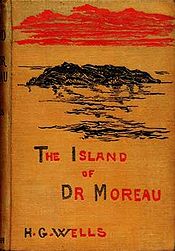
When the novel was written in 1896, European society was absorbed with concerns about degeneration, and Britain's scientific community was engulfed by debates on animal vivisection. Interest groups were even formed to tackle the issue: the British Union for the Abolition of Vivisection was formed two years after the publication of the novel.
It begins with the protagonist, an upper class gentleman named Edward Prendick, finding himself shipwrecked in the ocean. A passing ship takes him aboard, and a man named Montgomery revives him. He explains to Prendick that they are bound for an unnamed island where he works, and that the animals aboard the ship are traveling with him. Prendick also meets a grotesque, bestial native named M'ling, who appears to be Montgomery's manservant.
When they arrive on the island, however, both the captain of the ship and Montgomery refuse to take Prendick with them, stranding him between the ship and the island. The crew pushes him back into the lifeboat from which they rescued him. When they see that the ship truly intends to abandon him, the islanders take pity and end up coming back for him. When they arrive at their island, Montgomery introduces Prendick to Doctor Moreau, a cold and precise man who conducts research on the island. After unloading the animals from the boat, they decide to house Prendick in an outer room of the enclosure in which they live. Prendick is exceedingly curious about what exactly Moreau researches on the island, especially after he locks the inner part of the enclosure without explaining why. Prendick suddenly remembers that he has heard of Moreau, and that he had been an eminent physiologist in London before a journalist exposed his gruesome experiments in vivisection.
The next day, Moreau begins working on a puma, and its anguished cries drive Prendick out into the jungle. As he wanders, he comes upon a group of people who seem human but have an unmistakable resemblance to hogs. As he walks back to the enclosure, he suddenly realizes he is being followed. He panics and flees, and, in a desperate attempt at defense, he manages to stun his attacker, a monstrous hybrid of animal and man. When he returns to the enclosure and questions Montgomery, Montgomery refuses to be open with him. After failing to get an explanation, Prendick finally gives in and takes a sleeping draught.
Prendick awakes the next morning with the previous night's activities fresh in his mind. Seeing that the inner door has been left unlocked, he walks in to find a humanoid form lying in bandages on the table before he is ejected by a shocked and angry Moreau. He believes that Moreau has been vivisecting humans and that he is the next test subject. He flees into the jungle, where he meets an Ape Man who takes him to a colony of similarly half-human/half-animal creatures. The leader, a large gray thing named the Sayer of the Law, has him recite a strange litany called the Law that involves prohibitions against bestial behavior and praise for Moreau. Suddenly, Moreau bursts into the colony, and Prendick escapes out the back into the jungle. He makes for the ocean, where he plans to drown himself rather than allow Moreau to experiment on him. Moreau and Montgomery confront him, however, and Moreau explains that the creatures, the Beast Folk, are animals he has vivisected to resemble humans. Prendick goes back to the enclosure, where Moreau explains to him that he has been on the island for eleven years now, striving to make a complete transformation from animal to human. Apparently, his only reason for the pain he inflicts is scientific curiosity. Prendick accepts the explanation as it is and begins life on the island.
One day, as he and Montgomery are walking around the island, they come across a half-eaten rabbit. Eating flesh and tasting blood is one of the strongest prohibitions in the Law, so Montgomery and Moreau become very worried. Moreau calls an assembly of the Beast Men. He identifies the Leopard Man (the same one that chased Prendick the first time he wandered into the jungle) as the transgressor. The Leopard Man flees, but when the group corners him in some undergrowth, Prendick takes pity and shoots him, sparing him a return to the operating table in Moreau's "House of Pain". Prendick also believes that, although the Leopard Man was seen breaking several laws such as drinking water bent down like an animal, chasing men (i.e. Prendick) and running on all fours, the Leopard Man was not responsible for the deaths of the rabbits, but it was the Hyena-Swine, the other most dangerous beast man on the island. He doesn't, however, tell anyone this. Moreau is furious that Prendick killed the Leopard Man but can do nothing about the situation.
As time passes, Prendick begins to deaden himself to the grotesqueness of the Beast Folk. One day, however, he is shaken out of this stagnation when the puma rips free of its restraints and escapes from the lab. Moreau pursues it, but the two end up killing each other. Montgomery falls apart, and having gotten himself quite drunk, decides to share his alcohol with the Beast Men. Prendick tries to stop him, but Montgomery threatens violence and leaves the enclosure alone with bottle in hand. Later in the night, Prendick hears a commotion outside; he rushes out, and sees that Montgomery appears to have been involved in some scuffle with the Beast Folk. He dies in front of Prendick, who is now the last remaining human on the island. After the death, Prendick notices the sky behind him grow brighter and sees that the enclosure is on fire. He realizes that he had knocked over a lamp while rushing out to find Montgomery and that he has no chance of saving any of the provisions stored in the enclosure. He suddenly decides to flee from the island but notices that Montgomery has burnt the only boats, in order to prevent their return to mankind.
He does not attempt to claim Moreau's vacant throne on the island, but he instead settles for living with the Beast Folk as he attempts to build and provision a raft with which he intends to leave the island. He lives on the island for 10 months after the deaths of Moreau and Montgomery. As the time goes by, the Beast Folk increasingly revert to their original animal instincts, beginning to hunt the island's rabbits, returning to walking on all fours, and leaving their shared living areas for the wild. They also gradually cease to follow Prendick's instructions and eventually kill his faithful companion, a Beast-Man created from a dog. Luckily for him, eventually a boat carrying two corpses drifts onto the beach (it is heavily implied that these are the bodies of the captain of the ship that picked Prendick up, and a sailor, due to it being revealed in the book's introduction that said ship sank, and due to one of the corpses having ginger hair). Prendick dumps the bodies, gets supplies, and leaves the next morning.
He is picked up by a ship only three days later, but when he tells his story the crew thinks he is mad. To prevent himself from being declared insane, he pretends to have no memory of the year he spent between the first shipwreck and his final rescue. When he gets back to England, however, he finds that he is rigidly uncomfortable around other humans, because he has an irrational suspicion that they are all Beast Folk in danger of sudden and violent reversion to animalism. He contents himself with solitude and the study of chemistry and astronomy, finding peace above in the heavenly bodies.
DOWNLOAD HERE
The Thirty Nine Steps

Richard Hannay, the protagonist and narrator, an expatriate Scot, returns from a long stay in Southern Africa to his new home, a flat in London. One night he is buttonholed by a stranger, a well-travelled American, who claims to be in fear for his life. The man appears to know of an anarchist plot to destabilise Europe, beginning with a plan to assassinate the Greek Premier, Karolides, during his forthcoming visit to London. He reveals his name to be Franklin P. Scudder. Hannay lets Scudder hide in his flat, and returns later the next day to find that another man has been found shot dead in the same building, apparently a suicide. Four days later Hannay returns home to find Scudder dead with a knife through his heart.
Hannay fears that the murderers will come for him next, but cannot ask the police for help because he is the most likely suspect for the murders. Not only does he want to avoid imprisonment, but he also feels a duty to take up Scudder's cause and save Karolides from the assassination, planned in three weeks' time. He decides to go into hiding in Scotland and then to contact the authorities at the last minute. In order to escape from his flat unseen, he bribes the milkman to lend him his uniform and exits wearing it. Carrying Scudder's pocket-book, he catches a train to Scotland.
Arriving at the countryside somewhere near Galloway, Hannay lodges in a shepherd's cottage. The next morning he reads in a newspaper that the police are looking for him in Scotland. He boards a local train and jumps off between stations. He is seen but escapes, finding an inn where he stays the night. He tells the innkeeper a modified version of his story, and the man is persuaded to shelter him. While staying at the inn, Hannay cracks the substitution cipher used in Scudder's pocket-book. The next day two men arrive at the inn looking for Hannay, but the innkeeper sends them away. When they return later, Hannay steals their car and escapes.
On his way, Hannay reflects on what he has learnt from Scudder's notes. They contradict the story that Scudder first told to him, and mention an enemy group called the Black Stone and the mysterious Thirty-nine Steps. The United Kingdom appears to be in danger of an invasion by Germany and its allies. By this time, Hannay is being pursued by an aeroplane, and a policeman in a remote village has tried to stop him. Trying to avoid an oncoming car, Hannay crashes his own, but the other driver offers to take him home. The man is Sir Harry, a local landowner and prospective politician, although politically very naive. When he learns of Hannay's experience of South Africa, he invites him to address an election meeting that afternoon. Hannay's speech impresses Sir Harry, and Hannay feels able to trust him with his story. Sir Harry writes an introductory letter about Hannay to a relation in the Foreign Office.
Hannay leaves Sir Harry and tries to hide in the countryside, but is spotted by the aeroplane. Soon he spots a group of men on the ground searching for him. Miraculously, he meets a road mender out on the moor, and swaps places with him, sending the workman home. His disguise fools his pursuers, who pass him by. On the same road he meets a rich motorist, whom he recognises from London, and whom he forces to exchange clothes with him and drive him off the moor.
The next day, Hannay manages to stay ahead of the pursuers, and hides in a cottage occupied by an elderly man. Unfortunately, the man turns out to be one of the enemy, and with his accomplices he imprisons Hannay. Fortunately, the room in which Hannay is locked is full of bomb-making materials, which he uses to break out of the cottage, injuring himself in the process.
A day later, Hannay retrieves his possessions from the helpful roadmender and stays for a few days to recover from the explosion, and catches a train to England, to meet Sir Harry's relative at the Foreign Office, Sir Walter Bullivant, at his country home in Berkshire. As they discuss Scudder's notes, Sir Walter receives a phone call to tell him that Karolides has been assassinated.
Sir Walter, now at his house in London, lets Hannay in on some military secrets before releasing him to go home. Hannay is unable to shake off his sense of involvement in important events, and returns to Sir Walter's house where a high-level meeting is in progress. He is just in time to see a man, whom he recognises as one of his former pursuers in Scotland, leaving the house. Hannay warns Sir Walter that the man, ostensibly the First Sea Lord, is about to return to Europe with the information he has obtained from their meeting. At that point, Hannay realises that the phrase "the thirty-nine steps" could refer to the landing-point in England from which the spy is about to set sail. Throughout the night Hannay and the United Kingdom's military leaders try to work out the meaning of the mysterious phrase.
After some reasoning worthy of Sherlock Holmes, and with the help of a knowledgeable coastguard, the group decide on a coastal town in Kent. They find a path down from the cliff that has thirty-nine steps. Just offshore they see a yacht. Posing as fishermen, some of the party visit the yacht, the Ariadne, and find that at least one of the crew appears to be German. The only people onshore are playing tennis by a villa and appear to be English, but they match Scudder's description of the conspirators, The Black Stone. Hannay, alone, confronts the men at the villa. After a struggle, two of the men are captured while the third flees to the yacht, which meanwhile has been seized by the British authorities. The plot is thwarted, and the United Kingdom enters the First World War having kept its military secrets from the enemy.
A few weeks later, Hannay joins the army with a captain's rank.
DOWNLOAD HERE
The Time Machine

The book's protagonist is an English scientist and gentleman inventor living in Richmond, Surrey, identified by a narrator simply as the Time Traveller. The narrator recounts the Traveller's lecture to his weekly dinner guests that time is simply a fourth dimension, and his demonstration of a tabletop model machine for travelling through it. He reveals that he has built a machine capable of carrying a person, and returns at dinner the following week to recount a remarkable tale, becoming the new narrator:
The Time Traveller tests his device with a journey that takes him to the year 802,701 A.D., where he meets the Eloi, a society of small, elegant, androgynous, and childlike people. They live in small communities within large and futuristic yet slowly deteriorating buildings, doing no work and having a frugivorous diet. His efforts to communicate with them are hampered by their lack of curiosity or discipline, and he speculates that they are a peaceful communist society, the result of humanity conquering nature with technology, and subsequently evolving to adapt to an environment in which strength and intellect are no longer advantageous to survival.
Returning to the site where he arrived, the Time Traveller finds his time machine missing, and eventually works out that it has been dragged by some unknown party into a nearby structure with heavy doors, locked from the inside. Later in the dark, he is approached menacingly by the Morlocks, pale, apelike people who live in darkness underground, where he discovers the machinery and industry that makes the above-ground paradise possible. He alters his theory, speculating that the human race has evolved into two species: the leisured classes have become the ineffectual Eloi, and the downtrodden working classes have become the brutish light-fearing Morlocks. Deducing that the Morlocks have taken his time machine, he explores the Morlock tunnels, learning that they feed on the Eloi. His revised analysis is that their relationship is not one of lords and servants but of livestock and ranchers, and with no real challenges facing either species. They have both lost the intelligence and character of Man at its peak.
Meanwhile, he saves an Eloi named Weena from drowning as none of the other Eloi take any notice of her, and they develop an innocently affectionate relationship over the course of several days. He takes Weena with him on an expedition to a distant structure that turns out to be the remains of a museum, where he finds a fresh supply of matches and fashions a crude weapon against Morlocks, whom he fears he must fight to get back his machine. He plans to take Weena back to his own time. But because the long and tiring journey back to Weena's home is too much for them, they are overcome by Morlocks in the night, and Weena faints. The Traveller escapes only when a small fire he had left behind them to distract the Morlocks catches up to them as a forest fire; Weena is lost to the fire and the Morlocks are possibly killed by it.
The Morlocks use the time machine as bait to ensnare the Traveller, not understanding that he will use it to escape. He travels further ahead to roughly 30 million years from his own time. There he sees some of the last living things on a dying Earth, menacing reddish crab-like creatures slowly wandering the blood-red beaches of a world covered in simple vegetation. He continues to make short jumps through time, seeing Earth's rotation gradually cease and the sun grow dimmer, and the world falling silent and freezing as the last degenerate living things die out.
Overwhelmed, he returns to his laboratory, at just three hours after he originally left. Interrupting dinner, he relates his adventures to his disbelieving visitors, producing as evidence two strange flowers Weena had put in his pocket. The original narrator takes over and relates that he returned to the Time Traveller's house the next day, finding him in final preparations for another journey. The Traveler promises to return in half an hour, but three years later, the narrator despairs of ever learning what became of him, although just before he left the lab he saw a glimpse of him.
DOWNLOAD HERE
The Strange Case of Dr Jekyll
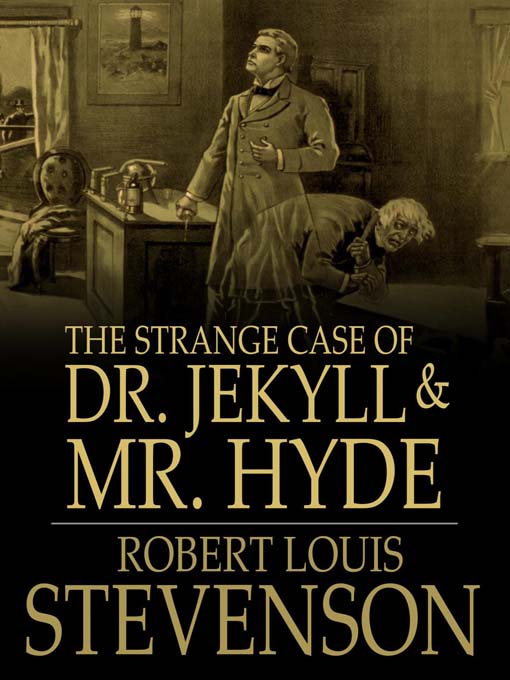
Gabriel John Utterson, a lawyer, is on his weekly walk with his relative Richard Enfield, who proceeds to tell him of an encounter he had some months ago while coming home late at night (it is not known what he was coming home from). The tale describes a sinister figure named Mr Hyde who tramples a young girl, disappears into a door on the street, and re-emerges to pay off her relatives with a cheque signed by a respectable gentleman for 100 pounds. Because both Utterson and Enfield disapprove of gossip, they agree to speak no further of the matter. It happens, however, that one of Utterson’s clients and close friends, Dr Henry Jekyll, has written a will transferring all of his property to this same Mr Hyde. Soon, Utterson begins having dreams in which a faceless figure stalks through a nightmarish version of London. Puzzled, the lawyer visits Jekyll and their mutual friend Dr Hastie Lanyon to try to learn more. Lanyon reports that he no longer sees much of Jekyll, since they had a dispute over the course of Jekyll’s research, which Lanyon calls “unscientific balderdash”. Curious, Utterson stakes out a building that Hyde visits, which, it turns out, is a filthy shack attached to the back of Jekyll’s home.
Encountering Hyde, Utterson is amazed by how ugly the man seems, as if deformed, though Utterson cannot say exactly how this is so. Much to Utterson’s surprise, Hyde willingly offers Utterson his address. Jekyll tells Utterson not to concern himself with the matter of Hyde. A year passes uneventfully. One night, a servant girl witnesses Hyde beat a man to death with a heavy cane - MP Sir Danvers Carew, also a client of Utterson. The police contact Utterson, who suspects Hyde of the murder. He leads the officers to Hyde’s apartment, feeling a sense of foreboding amid the eerie weather (the morning is dark and wreathed in fog). When they arrive at the apartment, the murderer has vanished, but they find half of the cane (described as being made of a strong wood but broken due to the beating) left behind a door. It is revealed to have been given to Jekyll by Utterson. Shortly thereafter, Utterson again visits Jekyll, who now claims to have ended all relations with Hyde. Jekyll shows Utterson a note, allegedly written to Jekyll by Hyde, apologizing for the trouble he has caused him and saying goodbye. That night, however, Utterson’s clerk points out that Hyde’s handwriting bears a remarkable similarity to Jekyll’s own.
For a few months, Jekyll reverts to his former friendly and sociable manner, as if a weight has been lifted from his shoulders. Later, Jekyll suddenly begins to refuse visitors, and Lanyon dies of shock after receiving information relating to Jekyll. Before his death, Lanyon gives Utterson a letter, with instructions that he not open it until after Jekyll's death or disappearance. Utterson goes out walking with Enfield, and they see Jekyll at a window of his laboratory; the three men begin to converse, but a look of horror comes over Jekyll’s face, and he slams the window and disappears. Soon afterward, Jekyll’s butler, Mr Poole, visits Utterson in a state of desperation and explains that Jekyll has secluded himself in his laboratory for several weeks, and that now the voice that comes from the room sounds nothing like the doctor’s. Utterson and Poole travel to Jekyll’s house through empty, windswept, sinister streets; once there, they find the servants huddled together in fear. After arguing for a time, the two of them resolve to break into Jekyll’s laboratory.
Inside, they find the body of Hyde, wearing Jekyll’s clothes and apparently dead by suicide. They find also a letter from Jekyll to Utterson promising to explain the entire mystery. Utterson takes the document home, where first he reads Lanyon’s letter and then Jekyll's. The first reveals that Lanyon’s deterioration and eventual death were caused by the shock of seeing Mr Hyde drink a potion and, as a result of doing so, metamorphose into Dr Jekyll. The second letter explains that Jekyll, seeking to separate his good side from his darker impulses, discovered a way to transform himself periodically into a creature free of conscience, this being Mr Hyde. The transformation was incomplete, however, in that it created a second, evil identity, but did not make the first identity purely good. At first, Jekyll reports, he delighted in becoming Hyde and rejoiced in the moral freedom that the creature possessed. Eventually, however, he found that he was turning into Hyde involuntarily in his sleep, even without taking the potion.
At this point, Jekyll resolved to cease becoming Hyde. One night, however, the urge gripped him too strongly, and after the transformation he immediately rushed out and violently killed Sir Danvers Carew. Horrified, Jekyll tried more adamantly to stop the transformations, and for a time he proved successful by engaging in philanthropic work. At a park, he considers how good a person he has become as a result of his deeds (in comparison to others), believing himself redeemed. However, before he completes his line of thought, he looks down at his hands and realizes that he has suddenly once again become Mr Hyde. This was the first time that an involuntary metamorphosis had happened in waking hours. Far from his laboratory and hunted by the police as a murderer, Hyde needed Lanyon’s help to get his potions and become Jekyll again; when he undertook the transformation in Lanyon’s presence, the shock of the sight instigated Lanyon’s deterioration and death. Meanwhile, Jekyll returned to his home, only to find himself ever more helpless and trapped as the transformations increased in frequency and necessitated even larger doses of potion in order to reverse themselves. It was the onset of one of these spontaneous metamorphoses that caused Jekyll to slam his laboratory window shut in the middle of his conversation with Enfield and Utterson.
Eventually, the potion began to run out, and Jekyll was unable to find a necessary ingredient to make more. Ironically, Jekyll learns that this most necessary ingredient was in the first instance of his experiments, sullied. Subsequent supplies are pure and thus lacking the quality that makes the potion successful for his experiments. His ability to change back from Hyde into Jekyll slowly vanished. Jekyll writes that even as he composes his letter he knows that he will soon become Hyde permanently, and he wonders if Hyde will face execution for his crimes or choose to kill himself. Jekyll notes that, in either case, the end of his letter marks the end of the life of Dr Jekyll. He ends the letter saying "This is the end of Dr Jekyll. Goodbye... Good..." . With these words, both the document and the novel come to a close.
download here
Langganan:
Postingan (Atom)
